Ants
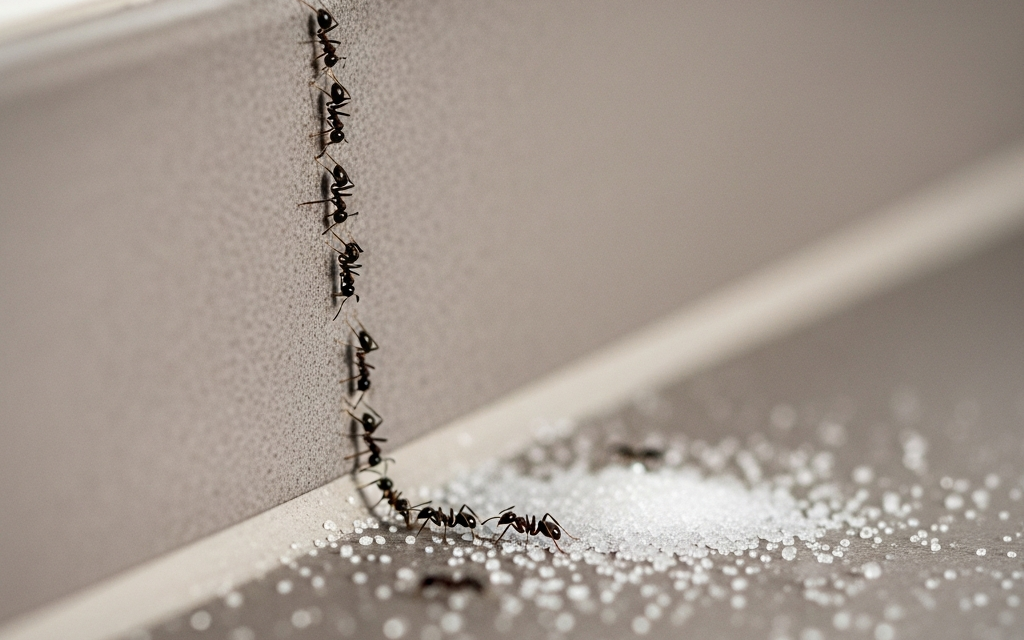
Ants (family Formicidae) are social insects that form highly organized colonies with differentiated castes: queens, workers, and, in some species, soldiers. In Mexico, the most common pest species include the carpenter ant (Camponotus spp.), the pharaoh ant (Monomorium pharaonis), the Argentine ant (Linepithema humile), and the fire ant (Solenopsis invicta). Each has distinct habits, diets, and risk levels, so correctly identifying the species is the first step toward any effective control.
Identification
Ants measure from 1 to 13 mm depending on species and caste, and their coloration ranges from black to brown, red, or yellow. Their body has three defined segments (head, thorax, and abdomen) separated by a narrow waist, and their elbowed antennae are a distinctive feature that sets them apart from termites. Colonies range from hundreds to millions of individuals.
It is important to distinguish the carpenter ant from the termite: both excavate wood, but the carpenter ant does not consume it; it only creates galleries to nest, leaving behind a characteristic fine sawdust. Termites, by contrast, do digest cellulose and rarely leave visible sawdust.
Signs of infestation
Catching an infestation early makes control far easier. The most common signs are:
- Foraging trails: continuous lines of workers running along baseboards, window frames, or countertops toward a food source.
- Fine, very uniform sawdust accumulating beneath frames, beams, or wooden baseboards, a typical sign of carpenter ants.
- Small mounds of soil in patios, pavement joints, or planters that mark the entrance to the nest.
- Winged ants indoors, a sign of a nuptial flight and a mature, established colony nearby.
Ants tend to appear more intensely after rain: water floods their underground nests and forces them to seek shelter inside structures, while moisture also favors the fungi that some species cultivate.
Risks
Beyond the nuisance, ants pose concrete health and structural risks. They contaminate food and surfaces as they travel between garbage, drains, and food-preparation areas. Fire ants deliver painful stings that can trigger severe allergic reactions, including anaphylaxis in sensitive individuals. Carpenter ants progressively weaken beams, frames, and wooden structures as they expand their galleries. In hospitals and clinics, the pharaoh ant is especially dangerous because it transports pathogens between sterile and contaminated areas, compromising safety. In the food industry, their presence generates non-conformities in health audits.
How Fucesa controls it
At Fucesa we apply an Integrated Pest Management (IPM) approach that prioritizes identification, inspection, and targeted treatments over blanket applications. The process includes:
- Species identification and nest location, since treating the Argentine ant differs from treating the carpenter or pharaoh ant.
- Gel baits or stations that workers carry back to the nest, eliminating the queen and the entire colony from within.
- Targeted perimeter treatments at entry points and foraging routes rather than generalized fogging.
- Follow-up monitoring to confirm elimination and prevent recurrence.
Prevention
Prevention reduces the likelihood of reinfestation and reinforces the treatment result. Practical measures:
- Clean spills immediately and store food in airtight containers.
- Seal cracks, joints, and entry points in walls, windows, and pipes.
- Control moisture: repair leaks and remove wet or decaying wood that attracts carpenter ants.
- Keep vegetation and branches away from the facade to remove bridges into the interior.
When to call a professional
If ants return despite home remedies, if you detect carpenter-ant sawdust, if there are fire-ant stings, or if the activity occurs in a sensitive setting (hospital, restaurant, food plant), it is time to call a professional. Poorly applied baits can fragment the colony and multiply nests instead of eliminating them.
At Fucesa we have over 40 years of experience in pest control and operate in accordance with NOM-256-SSA1-2012 and with COFEPRIS registration, ensuring safe, technically backed treatments for homes, businesses, and industry.
For more on why ants appear at home and when to fumigate, or service in Toluca, request a quote.