Wasps: how to remove the nest and control them
Quick answer
If wasps keep entering and leaving the same point on an eave, wall, or attic, there is almost certainly an active nest. Professional control is not blind spraying: identify the species, treat and remove the nest with protective gear (best at dawn or dusk), then seal cavities so another colony cannot return. See the full wasp nest at home guide; below, signs, risks, and when to request an inspection in Toluca, Mexico City, or Querétaro.
Wasps (order Hymenoptera, suborder Apocrita) include social and solitary species. In Mexico, the most problematic near homes and businesses are paper wasps (Polistes spp.), yellow jackets (Vespula spp.), and hornets (Vespa spp.). Unlike bees, a wasp can sting multiple times and becomes aggressive when defending a nest. They are useful insect predators, but nests on eaves, walls, attics, or walkways require Integrated Pest Management (IPM)—not improvised DIY fixes.
Identification
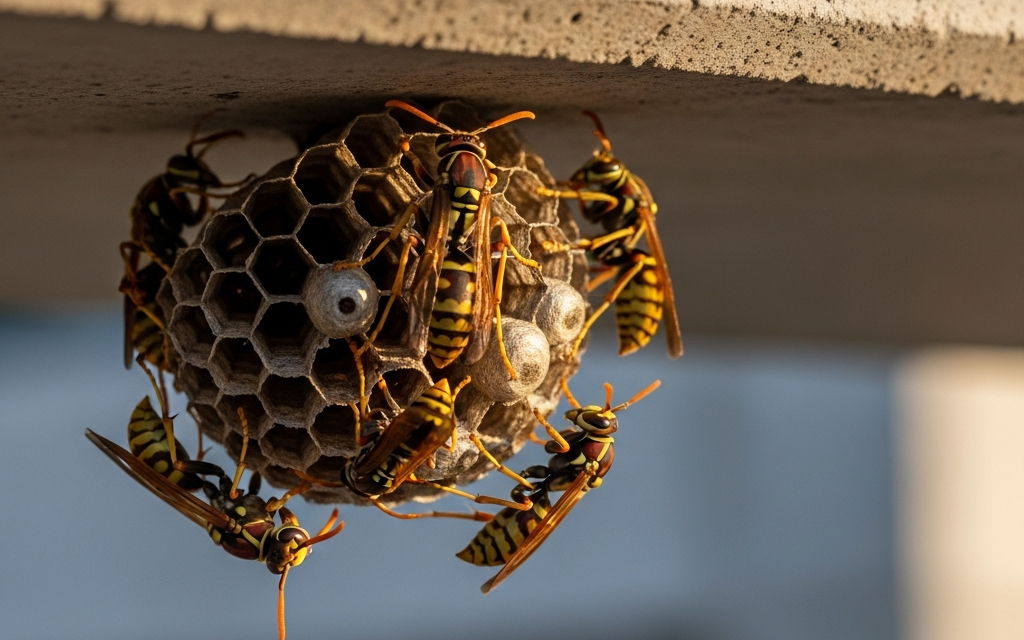
Size: 10 to 25 mm depending on the species. Color: yellow and black (yellow jacket), brown with bands (paper wasp), or black with light markings. The body has a very narrow waist between thorax and abdomen and little hair, which distinguishes wasps from bees. A single wasp near food does not always mean a colony; repeated traffic to the same wall or eave point usually signals an active nest.
Nests: the paper wasp (Polistes) builds open, umbrella-shaped combs; the yellow jacket (Vespula) makes enclosed, spherical paper nests, often in cavities, walls, attics or underground. They are commonly found on eaves, trees, cavities and structures. Behavior: they are insect predators and food scavengers, drawn to sweets, meats and beverages, particularly in late summer and autumn.
Nesting colonies vs solitary wasps
Not every wasp is the same. Social species (paper wasps, yellow jackets, hornets) form colonies: one nest can hold hundreds of individuals and is defended as a group. Solitary wasps do not keep large colonies and are usually less aggressive away from the nest site, though a sting is still painful.
Knowing nest vs solitary guides the response: a social nest near entrances, patios, or play areas needs professional removal; an occasional solitary wasp is often managed with exclusion and bait cleanup—not whole-house spraying.
Signs of infestation
- Wasps repeatedly entering and leaving through the same point in a wall, eave or cavity.
- Paper-like nests, small at the start of the season and growing steadily larger.
- Increased wasp activity around trash bins, outdoor tables and food areas.
- An audible buzzing inside walls or ceilings when the nest is hidden in a cavity.
When they are dangerous
Stings cause pain, swelling, and redness. In allergic people they can trigger anaphylaxis—that is a medical emergency, not a pest-control issue. Risk rises with an active nest near doors, windows, play areas, or food zones, or when someone tries to hit, burn, or seal the nest: the colony responds in force. In commercial, school, and recreation settings, nests also create operational and liability risk.
How we control it (IPM)
Professional wasp control centers on safe nest removal, not random insecticide. At Fucesa we follow Integrated Pest Management (IPM): inspect and identify the species, treat and remove the nest, seal cavities, and use baited traps only as monitoring support. IPM prioritizes safety and exclusion over indiscriminate product use.
- Inspection and location: pinpointing the nest and the species, since each one requires different handling.
- Nest treatment and removal: targeted application and physical removal of the nest, carried out with proper protective equipment and preferably at dawn or dusk, when the colony is least active.
- Cavity sealing: once the colony is eliminated, access points in walls, roofs and foundations are closed so another colony cannot reoccupy them.
- Baited traps: in areas of human activity, they help reduce populations and monitor the area.
Important: never try to burn, hit or seal a nest yourself; these actions provoke mass attacks. A single nest can hold hundreds or thousands of aggressive wasps.
When to treat or fumigate
Professional treatment is not blind spraying: it focuses on locating and neutralizing the nest with protective equipment, preferably at dawn or dusk. Call when there is an active nest people can reach, a nest hidden in a wall or ceiling, allergic occupants, or heavy traffic at patios and entrances. A lone solitary wasp rarely needs broad treatment; a social nest does.
Prevention
- Regularly inspect eaves, attics, trees and cavities for developing nests, when they are easy to remove.
- Cover food and beverages outdoors and keep garbage containers sealed.
- Seal cracks and access points to cavities in walls, roofs and foundations before nesting season.
- Pick up fallen fruit and food scraps from the garden, which attract scavenging wasps.
When to call a professional
Whenever you find an active nest—especially near entrances, windows, play areas, or walkways—keep your distance and contact pest control professionals. Call immediately if anyone on site is allergic or if the nest is hidden inside a wall or ceiling. For service in Toluca, CDMX, or Querétaro, ask for a quote before attempting DIY removal.
Frequently asked questions
How do I know if there is a wasp nest?
Repeated traffic to the same gap, paper-like nests on eaves or in cavities, and buzzing inside walls or ceilings are typical signs. A single wasp near food does not always mean a colony.
Do I need to fumigate the whole house?
No. The right approach is to locate and neutralize the nest, then seal access points. Blind spraying rarely solves a social colony and can increase aggression.
When should I call a professional?
When the nest is near entrances, patios, or walkways; if it is hidden in a wall or ceiling; or if anyone on site is allergic. Do not try to burn, hit, or seal the nest yourself.
Need wasp nest removal in Toluca, Mexico City (CDMX), or Querétaro? Request our insect control with certified technicians (NOM-256-SSA1-2012) and COFEPRIS registration. Over 40 years of experience from our Toluca headquarters and Querétaro base. Contact us for a quote—do not try to remove the nest yourself.