Pigeons
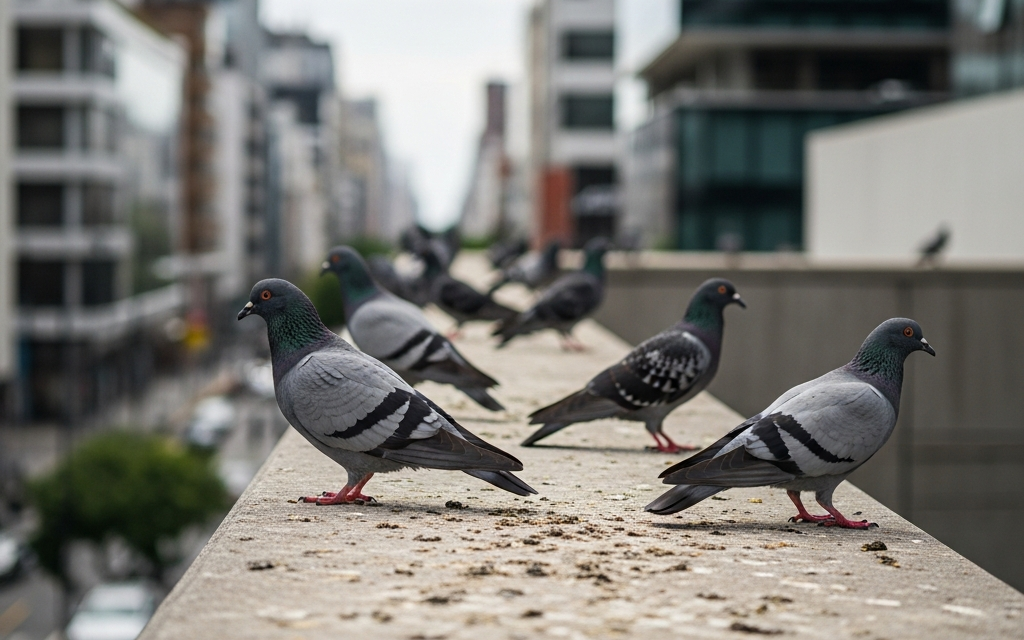
The domestic pigeon (Columba livia domestica) is one of the most widespread pest birds in urban environments. Originally from the Mediterranean, they have perfectly adapted to cities, where they find abundant food and structures that mimic the rocky cliffs of their natural habitat. A single pigeon produces over 12 kg of droppings per year, which is why an established colony quickly becomes both a health and a structural problem.
Identification
The domestic pigeon measures 30 to 35 cm in length, with a 60 to 70 cm wingspan and a weight of 250 to 380 grams. Its typical coloration is bluish gray with black bars on the wings and an iridescent neck, though there is wide variation. It builds rudimentary twig nests on ledges, eaves, rooftops, towers, and elevated structures that imitate cliffs.
Signs of infestation
Pigeons leave very visible traces when they establish a roost or nesting area:
- Accumulation of white-gray droppings on ledges, windows, facades, machinery, and parked vehicles.
- Feathers and nesting material (twigs, dry grass) on eaves, rooftops, ducts, and ventilation grilles.
- Cooing sounds and constant flapping on roofs, lofts, and elevated spaces.
- Gutters and drains clogged by nests, feathers, and accumulated droppings.
Risks
Pigeons are associated with more than 60 diseases, including histoplasmosis, cryptococcosis, and ornithosis (psittacosis), which can be transmitted by inhaling spores present in dry droppings. Their nests and feathers harbor mites and other parasites. The droppings contain uric acid that corrodes metal, stone, and concrete, damaging facades, machinery, and vehicles and causing economic losses in historic and commercial buildings. In addition, wet droppings create slippery surfaces that pose a fall hazard, and nests clog gutters and ventilation systems.
How Fucesa controls it
Pigeon control is bird management, not extermination. At Fucesa we apply humane exclusion and deterrence methods within an Integrated Pest Management (IPM) approach that respects local regulations:
- Physical exclusion: installation of bird netting, spikes, and tensioned wires to prevent perching and nesting without harming the birds.
- Deterrent devices: visual, auditory, and reflective devices that drive birds away from protected areas.
- Access sealing: closing openings in roofs, eaves, and facades that serve as nesting sites.
- Professional cleaning and disinfection of droppings with appropriate protective equipment, given the risk of histoplasmosis from spore inhalation.
Prevention
Removing access to perching and food is the key to keeping pigeons from returning:
- Eliminate food sources: do not leave food exposed or feed the birds, and cover garbage containers.
- Remove nests and debris early and safely, before the colony becomes established.
- Modify perching surfaces (angles, mesh) on ledges and wide sills to make them uncomfortable.
- Keep gutters, rooftops, and grilles clean so they do not offer attractive nesting spots.
When to call a professional
If pigeons nest at heights or on hard-to-reach structures, if there is significant droppings buildup, or if you need to protect a facade, an industrial building, or a heritage structure, professional control is advisable. Cleaning droppings carries a risk of histoplasmosis and must be done with protective equipment, and installing netting and spikes requires technique to be effective and discreet.
At Fucesa we have over 40 years of experience in pest and bird control, and we operate in accordance with NOM-256-SSA1-2012 and with COFEPRIS registration, using humane, safe, and technically backed methods for homes, businesses, and industry.